

Collect and route customer feedback
Productboard brings feedback into insights boards from portals, forms, forwarded email, imports, and connected support or chat tools. Teams can assign notes, filter them, and route them to the product manager responsible.
A Product Portal lets customers browse published ideas and submit requests. Teams can link feedback notes to related features, keeping the customer reason beside the proposed work.
Prioritise features with customer evidence
Teams can group feedback by customer segment and use fields or formulas to compare opportunities. Productboard supports scoring models such as RICE and value versus effort, with availability depending on the plan.
Portal visitors can rate the importance of published ideas, and linked feedback can contribute to a Customer Importance Score. These signals help teams judge demand without treating every vote as a promise.
Share columns and timeline roadmaps
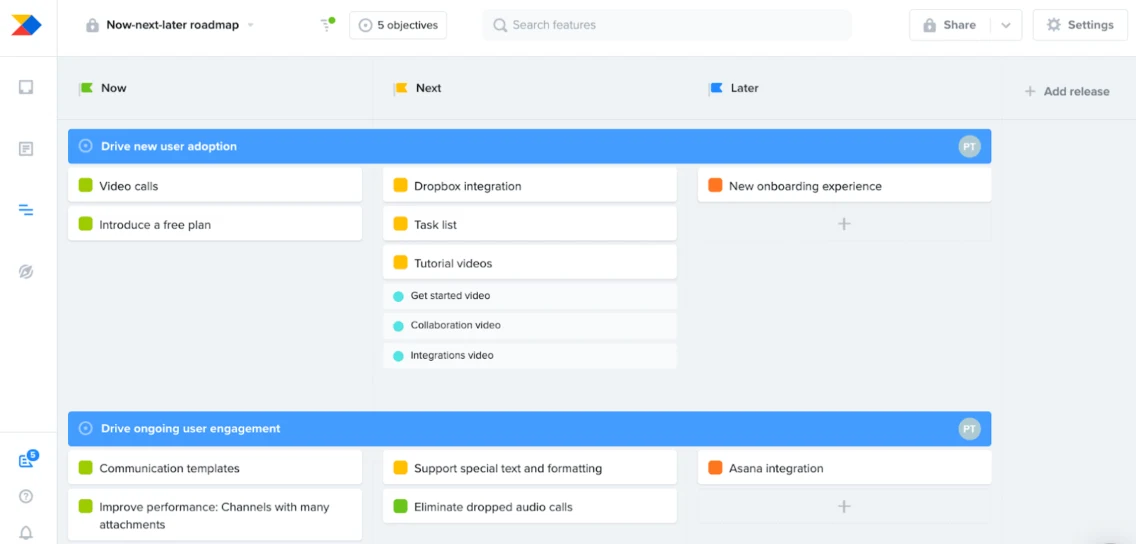
Productboard offers columns roadmaps for stages and timeline boards for work across weeks, months, or quarters. Eligible boards can be published for external stakeholders through a link or embed.
Makers and admins choose when to publish or unpublish. Edits saved to an already published board can become visible quickly, so review the audience and board contents before changing it.
Update people about requested features
Teams can publish timestamped updates on individual Portal cards and email people who requested the feature. This closes the loop on a request as its status changes.
The current research does not establish a separate chronological changelog or a dedicated AI workflow for drafting customer-facing release notes. Treat Portal updates as feature-level communication.
Sync Productboard plans with Jira
Productboard can push, import, or link items with Jira issues. Configured field and status mappings can sync changes in both directions between product planning and delivery.
The integration needs an authorised Jira user and compatible mappings. Productboard remains the separate workspace where teams manage insights and decide what to build.
Pricing
Productboard has a Free plan with one Product Portal and limits on feedback notes, contributors, and AI credits. Paid plans are priced per maker, while external portal visitors do not need maker accounts.
Plus starts at $19 per maker per month billed annually, or $25 billed monthly. Check the current limits for feedback, teamspaces, portals, and formulas before choosing a plan.
| Plan | Starting price | Billing basis |
|---|---|---|
| Free | $0/month | Plan limits |
| Plus | From $19/maker/month | Billed annually |
| Business | From $59/maker/month | 2 makers minimum |
USD. Plus costs $25 per maker per month on monthly billing. Checked 28 September 2026.
Who is Productboard a good fit for?
Productboard suits teams that want a full product-management workspace for feedback, prioritisation, roadmap planning, and stakeholder alignment.
For Jira teams, decide whether product decisions should live in Productboard with a sync to Jira, or whether Jira and Jira Product Discovery already provide the planning workspace you need.
