All comparisons

Canny vs Productboard

Canny suits small teams that want a dedicated feedback and product-planning system with customer voting, segmentation, and automatic feedback capture. Productboard suits product organisations that want customer feedback, prioritisation, roadmap planning, and portfolio coordination in a dedicated product management system.

Canny

Best for small teams with a dedicated feedback system

  • Advantage: Customer requests, votes, and discussions in one portal
  • Advantage: Customer segmentation and revenue context for prioritisation
  • Advantage: Automatic feedback capture and deduplication with Autopilot
  • Limitation: Internal idea fields cannot appear on the public portal
  • Limitation: Replies to notification emails do not become post comments

Productboard

Best for dedicated product planning and feedback intelligence

  • Advantage: Central feedback repository with linked product insights
  • Advantage: Customer, segment, and revenue context for prioritisation
  • Advantage: Portfolio roadmaps across products in one workspace
  • Limitation: AI release-note drafting and reusable release templates are unavailable
  • Limitation: Productboard access and planning records are administered separately from Jira

Feature comparison

✓ Supported · — Partially supported · × Not available.

Feature Canny Productboard
Pricing
Free plan and limits Compare the limits and scope of the free offering.
Supported 25 tracked users
Supported
Starting paid price Compare the entry paid plan, billing unit, and payment commitment. Free-plan limits are listed separately.
Pro: from $79/month, billed annually (100 tracked users)
Plus starts at $19 per maker/month billed annually, or $25 per maker/month billed monthly.
Pricing model Understand what drives the bill, such as seats, site size, or tracked users.
Your company pays for Canny based on the number of people whose feedback is tracked. Customers do not pay to submit feedback.
Paid plans are priced by makers, with plan-specific limits for contributors, feedback notes, AI credits, teamspaces, and portals.
Feedback collection and organisation
Feedback collection Collect ideas, requests, and problems from customers.
Supported
Supported
Feedback triage Review incoming feedback and organise it for follow-up.
Supported
Supported
End-user feedback portal Give customers a dedicated place to submit and browse feedback.
Supported
Supported
Respond to feedback Respond to customers and continue the feedback conversation.
Supported
Supported
Reply to feedback directly by email Record a customer’s email reply in the feedback thread without requiring a portal visit.
Not available
Not available
Feedback visibility controls Control whether feedback is private or visible to other customers.
Supported Custom access: Pro/Business
Supported
Dedicated feedback forms Collect feedback through a dedicated form embedded in a website or app.
Not available
Supported
Automatic feedback capture Extract feedback from connected conversations without manually creating each entry.
Supported
Supported
Comments and discussions Discuss a request and add context in a shared conversation.
Supported
Supported
Private internal notes Keep team discussion separate from customer-visible replies.
Supported
Supported
Prioritisation and customer context
Wishlists and customer voting Understand which requests matter to customers through votes or personal selections.
Supported
Supported
Personal customer wishlists Let customers maintain a personal selection of the features they want.
Not available
Not available
Configurable wishlist limits Limit customer selections so they must choose what matters most.
Not available
Not available
Hide demand counts Hide totals to reduce the influence of other customers’ choices.
Supported
Supported
Customer segmentation Analyse feedback from particular customer groups.
Supported
Supported
Revenue-based prioritisation Consider account revenue when assessing customer demand.
Supported
Supported
Custom scoring frameworks Score requests using criteria chosen by the team.
Supported
Supported
Prioritisation models Use formulas such as RICE or impact versus effort to compare priorities.
Supported
Supported
Roadmap views and sharing
Public roadmaps Share upcoming work and progress with customers or stakeholders.
Supported Custom columns: Pro/Business
Supported
Board roadmap view Organise roadmap items into columns by status or planning stage.
Supported
Supported
Timeline view Show planned work against dates on a timeline.
Not available
Supported
Roadmaps across multiple projects Bring work from multiple projects into one shared roadmap.
Not available
Supported
Advanced roadmap filtering Choose which work appears using filters or advanced queries.
Not available
Supported
Separate customer-facing descriptions Write a customer-facing explanation separately from the internal planning description.
Not available
Supported
Show planning fields on the public roadmap Choose which internal planning fields customers can see on published items.
Not available
Supported
Control over roadmap publishing Decide when internal changes become visible to customers.
Supported
Supported
Release communication
Release notes Publish updates that explain what has changed in the product.
Supported
Limited Portal card updates publish timestamped progress or launch messages for individual features.
Release-note drafting workflow Compare where AI drafting happens and how source material reaches the writer.
External AI assistant through MCP on Pro/Business; built-in drafting unverified
Productboard does not provide an AI workflow specifically for drafting customer-facing release notes.
Reusable release-note templates Reuse an agreed structure when preparing each product update.
Not available
Not available
Configurable AI writing instructions Guide generated writing with tone, examples, or custom instructions.
Not available
Not available
Embedded product updates Show product updates directly inside a website or application.
Supported
Limited Portals and published roadmaps can be embedded, including Portal cards that contain timestamped updates.
Changelog email subscriptions Let readers subscribe to product updates by email.
Supported Pro/Business
Supported
Shipment communication Tell customers when new work becomes available.
Supported
Supported
Request-specific status notifications Notify people about progress on the particular requests they follow.
Supported
Supported
Integrations
Jira integration Connect customer feedback and plans to delivery work in Jira.
Limited One Jira issue per idea; configured links and status mappings on Pro/Business
Supported
Website and app embeds Bring customer-facing content into an existing website or application.
Supported
Supported
Support tool integrations Bring feedback from support conversations into the product workflow.
Not available
Supported
Team chat integrations Connect team chat to feedback collection or notifications.
Not available
Supported
Publishing integrations Distribute product updates to other tools and channels.
Not available
Not available
API and webhooks Read or update data programmatically and react to product events.
Supported
Supported
Access and administration
Audience controls Choose which customers, teams, or individuals can access shared content.
Supported Pro/Business
Supported
External customer participation Let customers contribute without requiring an internal team licence.
Not available
Supported
Custom domains Publish customer-facing content under a domain your organisation controls.
Not available
Supported
SOC 2 compliance Assess the product’s documented SOC 2 compliance status.
Not available
Supported
Single sign-on Let users sign in through an existing identity provider.
Not available
Supported
Team roles and permissions Assign team members different responsibilities and access levels.
Not available
Supported

Canny

Best for small teams that want a dedicated feedback and product-planning system, with customer voting, structured ideas, prioritisation, and progress updates.

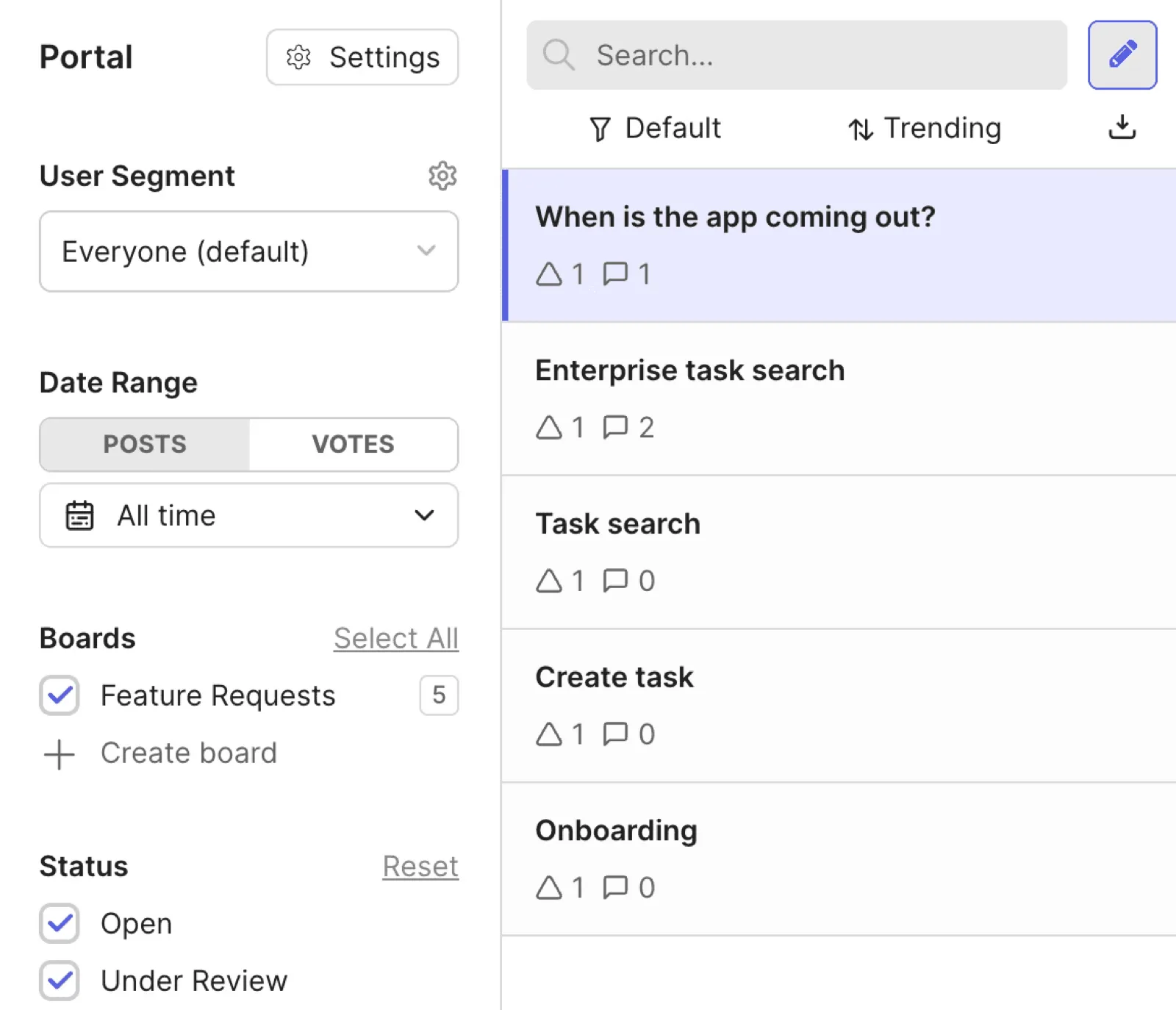
Canny feedback portal with feature requests, votes, and filters
Canny’s feedback portal brings requests, votes, and filters into one view.

Customer voting and discussion

Canny is a strong fit for small teams that want customer requests, votes, and discussions in a dedicated feedback portal. These interactions keep expressions of demand and the conversation around a request together.

Structured idea organisation

Canny supports teams that need to organise a growing collection of requests. Related ideas can be grouped, with customer evidence attached as insights so the context remains available during evaluation.

Customer segmentation and revenue context

Canny is particularly useful when demand needs to be assessed by customer group or commercial impact. Segmentation and revenue context help teams distinguish broadly popular requests from those important to particular accounts.

Automated feedback capture

Canny’s Autopilot reduces manual feedback intake by capturing and deduplicating feedback from connected sources. This is useful when customer input is spread across conversations; Autopilot is included across plans, with pricing based on tracked users.

Productboard

Best for product organisations that want customer feedback, prioritisation, roadmaps, and portfolio coordination in a dedicated product management system.

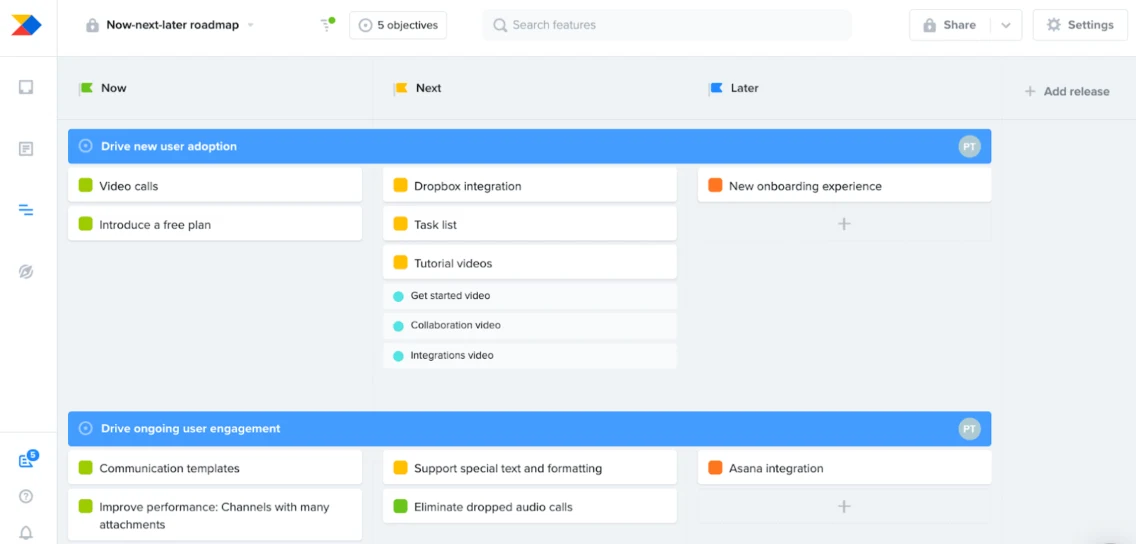
Productboard roadmap grouped by product objectives
Productboard brings product initiatives, objectives, and planning fields into a dedicated roadmap workspace.

Central feedback intelligence

Consolidate feedback from portals and connected customer channels, then link that evidence to product ideas.

Customer and revenue context

Use customer segments, importance scores, and aggregated commercial fields when prioritising work.

Portfolio roadmap planning

Combine multiple products in one workspace with configurable timeline and columns roadmaps.

Configurable Jira synchronisation

Connect Productboard planning records to Jira through mapped fields, statuses, and releases.

Key differences

Capability
Canny
Productboard

Feedback collection and conversations

Consider how easily customers can share feedback and continue the conversation with your team.

Replies sent directly to Canny comment-notification emails do not become post comments. Customers must open the post to comment. Teams can respond to requests and add internal comments.

Customers cannot reply to Portal update emails and have the response recorded in Productboard. Productboard recommends linking to a form or survey when more feedback is needed. Teams can publish timestamped updates on Portal cards and email them to people who requested the feature.

Roadmap presentation and publishing

Compare the context customers can see and the control your team has over sharing plans and progress.

Internal idea fields cannot be shown to end-users on the portal. This restriction applies even when the idea is published. Feedback submission form fields are a separate capability. Internal ideas can remain private until published; idea-to-post status syncing is configurable.

Published roadmaps can expose selected card attributes such as status, ownership, health, confidence, custom fields, and Customer Importance Score. Makers and admins explicitly publish or unpublish eligible roadmaps and can add a passcode.

Release-note creation and distribution

Consider how delivery work becomes a clear product update, from drafting through to publishing and distribution.

Connected AI assistants can create and update changelog entries through Canny’s MCP server. Pro or Business with Ideas enabled; appropriate role permissions and connector setup required.

Productboard does not provide an AI workflow specifically for drafting customer-facing release notes. General AI writing features are a different capability. Productboard does not provide reusable customer-facing release-note templates. Productboard does not provide configurable AI instructions for customer-facing release-note tone and format.

Customer demand and prioritisation

Look beyond vote totals to understand which requests matter, who needs them, and how they inform priorities.

Canny supports custom formulas and weighted impact-versus-effort scores. Feedback can be segmented by customer attributes and assessed by revenue impact.

Productboard supports configurable formulas and fields for evaluating product opportunities. Formula availability varies by plan. Customer segments group users or companies and can be used to filter feedback and prioritise features.

Aggregated customer fields can roll up values such as account ARR onto product items for prioritisation.

Sources and verification

Documentation reviewed 2026-09-15 / 2026-09-16. Based on product documentation and pricing sources.

Reviewed by Jens Schumacher

Last updated: